
 35 min read
 Beginner Level
 Lesson 1 of 12
Lesson Objective
By the end of this lesson, you will understand what digital audio is, how it differs from analog audio, and why this knowledge forms the foundation of all modern audio production work. This introductory lesson establishes the conceptual framework you need before diving into practical applications.
What You Will Learn
- The definition and characteristics of digital audio
- How analog sound is converted to digital format
- Key terminology used in digital audio production
- The historical evolution from analog to digital recording
- Why digital audio has become the industry standard
Required Knowledge or Tools
This lesson requires no prior knowledge of audio production. It is designed for absolute beginners who want to understand the fundamentals before exploring more advanced topics. You will benefit from having:
- Basic familiarity with using a computer
- Interest in understanding how audio technology works
- A willingness to learn technical concepts
No special software or hardware is needed for this introductory lesson.
Core Concept Explanation
Digital audio is sound that has been converted into a series of numbers that computers can store, manipulate, and reproduce. Unlike analog audio, which captures sound as continuous electrical signals, digital audio samples the sound at specific intervals and assigns numerical values to represent the amplitude at each point.
The Analog to Digital Conversion Process
When you speak into a microphone, your voice creates vibrations in the air. These vibrations cause a diaphragm inside the microphone to move, generating an electrical signal that mirrors the original sound wave. This is analog audio, a continuous representation of the sound.
To convert this analog signal to digital, an Analog-to-Digital Converter performs two critical operations. First, it samples the audio by measuring the amplitude of the signal thousands of times per second. Second, it quantizes these measurements by assigning each sample a numerical value from a fixed range of possibilities.
Key Terms: Sample Rate refers to how many times per second the audio is measured. Bit Depth determines how many possible values each sample can have. Standard CD quality uses 44,100 samples per second with 16 bits per sample.
Understanding Sample Rate
Sample rate, measured in Hertz, determines the frequency range that can be accurately captured. According to the Nyquist theorem, the sample rate must be at least twice the highest frequency you want to record. Human hearing extends to approximately 20,000 Hz, which is why the standard sample rate of 44,100 Hz was chosen for audio CDs.
Understanding Bit Depth
Bit depth determines the dynamic range and precision of each sample. A 16-bit system provides 65,536 possible values for each sample, while 24-bit systems offer over 16 million values. Higher bit depths result in lower noise floors and greater dynamic range, making them preferred for professional recording.
Visual Explanation
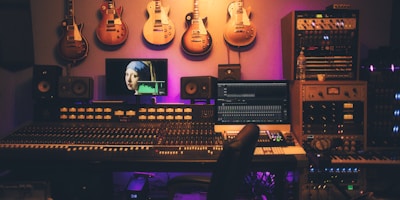
Modern digital audio production combines hardware and software to capture and manipulate sound with unprecedented precision.
The image above illustrates a typical digital audio production environment. Notice how analog sources like microphones connect to digital interfaces, which convert the sound into data that can be processed by computer software. This seamless integration of analog capture and digital processing is the foundation of contemporary audio production.
Why This Lesson Matters
Understanding digital audio fundamentals is essential because every subsequent concept in audio production builds upon this knowledge. When you adjust settings in your recording software, you are manipulating the parameters that define how sound is captured and represented digitally.
Without understanding sample rates, you might unknowingly record audio that cannot capture the full frequency spectrum of your source. Without understanding bit depth, you might introduce unwanted noise or limit your dynamic range during recording. These foundational concepts inform every decision you make as an audio producer.
Pro Insight: Professional audio engineers often record at higher sample rates and bit depths than the final delivery format requires. This provides headroom for processing and ensures the highest quality when the audio is eventually converted for distribution.
Step-by-Step Tutorial
Let us walk through the conceptual process of how digital audio is created:
- Sound Generation: A sound source creates vibrations in the air. This could be a musical instrument, a human voice, or any object that produces sound waves.
- Acoustic Capture: A microphone converts these air pressure variations into an electrical analog signal that mirrors the original sound wave pattern.
- Signal Routing: The analog signal travels through cables to an audio interface containing an Analog-to-Digital Converter.
- Sampling: The ADC measures the voltage of the analog signal at regular intervals determined by the sample rate setting.
- Quantization: Each sample is assigned a numerical value based on the bit depth, creating a digital representation of that moment in time.
- Data Storage: The series of numerical values is stored as digital data that can be saved, copied, edited, and transmitted without degradation.
Common Mistakes and Misunderstandings
Mistake 1: Believing that higher sample rates always sound better. While higher sample rates can capture ultrasonic frequencies, human ears cannot perceive them. The benefit lies in processing headroom, not audible improvement.
Mistake 2: Confusing bit depth with audio quality. Bit depth affects dynamic range and noise floor, not frequency response or tonal quality. A well-recorded 16-bit file can sound excellent.
Mistake 3: Assuming digital audio is inherently inferior to analog. Digital audio, when properly implemented, provides advantages in noise performance, repeatability, and editing flexibility that analog systems cannot match.
Mistake 4: Neglecting the importance of the analog components. The quality of microphones, preamps, and converters significantly impacts the final digital audio, regardless of sample rate or bit depth settings.
Practical Example or Scenario
Consider a podcaster recording an interview. The host speaks into a USB microphone connected to a laptop. Inside that microphone is an ADC sampling the audio at 48,000 Hz with 16-bit resolution. Every second, 48,000 measurements are taken, each represented by a number between 0 and 65,535.
The recording software receives this stream of numbers and writes them to a file. Later, during editing, the podcaster can see a visual representation of these numbers as a waveform. They can cut sections, adjust volume, and apply effects, all by mathematically manipulating the numerical data.
When the final episode is exported, the software converts the edited numbers back into an analog signal through the Digital-to-Analog Converter in the computer or headphones, allowing listeners to hear the reconstructed sound waves.
Lesson Summary
Digital audio represents sound as a series of numerical values captured through sampling and quantization. Sample rate determines how many measurements occur per second, while bit depth determines the precision of each measurement. This digital representation enables perfect copies, precise editing, and flexible processing that would be impossible with analog systems.
The conversion from analog to digital happens through ADCs, and the reverse occurs through DACs. Understanding this process helps you make informed decisions about recording settings and equipment choices throughout your audio production journey.
In the next lesson, we will explore sound waves in greater detail, examining the physical properties that digital audio systems must capture and reproduce accurately.